

Sanjeev Asthana, CEO of Patanjali Foods said, “On HPC, we will definitely witness anywhere between 12 to 15% annualised growth. We are witnessing the momentum, compared to in November when we took over the business last year definitely, we should gain 12 to 15% this year, and I am pretty much expecting, by end of this fiscal we should definitely be up apple to apple comparison, close to 10 to 12%.”
Asthana said the company is already seeing an improvement in demand after the GST cuts, particularly in rural markets, where the home and personal care segment has shown an early pickup and improving momentum. He added that urban demand has been slower to respond but is expected to improve with a lag.
He expects the demand environment to strengthen meaningfully in the second half of the year, with both the third and fourth quarters showing clear improvement. While the initial boost from the GST cuts may moderate over time, it is likely to leave the company on a structurally higher growth base of around 300–400 basis points.
The foods business has been relatively slower, largely due to weak urban demand, but management remains confident of a pickup. On the foods side, growth has typically been in the 8–10% range, but urban demand has remained weaker. As a result, the company now expects food volumes to grow around 6–8% by the end of the financial year, which is broadly in line with the targets set at the start of the year.
Patanjali Foods is also pushing ahead with its long-term strategy to increase the share of FMCG in its overall revenue mix. Asthana reiterated that the company aims to make FMCG nearly 50% of total revenue over the next three years, supported by faster growth compared to the edible oil business.
On edible oils, Asthana said the first half of the year remained flat due to lower prices and some demand contraction, but the second half has improved. “The pickup is quite good in the third quarter, and the estimation is for the fourth as well,” he said. For the full year, the company expects around 3% growth in edible oil volumes, with growth stabilising at 3–4% annually going forward.
Margins in the edible oil business are expected to remain stable. Asthana said margins stood at about 3.5% in the first half and should move closer to 4% for the full year.
Patanjali Foods currently has close to a 10% market share in edible oils and expects industry consolidation to benefit larger players.
A key long-term growth lever for the company is its oil palm plantation business. Asthana said Patanjali Foods has crossed 110,000 hectares under plantation and expects earnings before interest, taxes, depreciation, and amortisation (EBITDA) from this segment to exceed ₹300 crore this year. “This is going to be a big driver of growth,” he said, adding that the business should grow at 10–15% annually and help reduce dependence on imports over time.
At a blended level, Patanjali Foods expects margins to improve steadily. “We should be at 6% and progressively add about 100 basis points every year,” Asthana said.
He reiterated the company’s long-term goal of reaching ₹50,000 crore in revenue and ₹5,000 crore in EBITDA over the next three to four years.
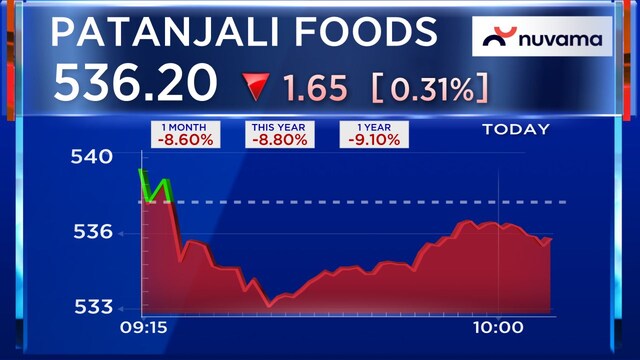
Patanjali Foods’s current market capitalisation is ₹58,280 crore. The stock is currently trading at ₹535.95 as of 10:06 am on the NSE and has declined 10% over the last year.
For full interview, watch accompanying video
Follow our live blog for more stock market updates